
HIS STORY
IN HIS NAME
The chambers he was denied.
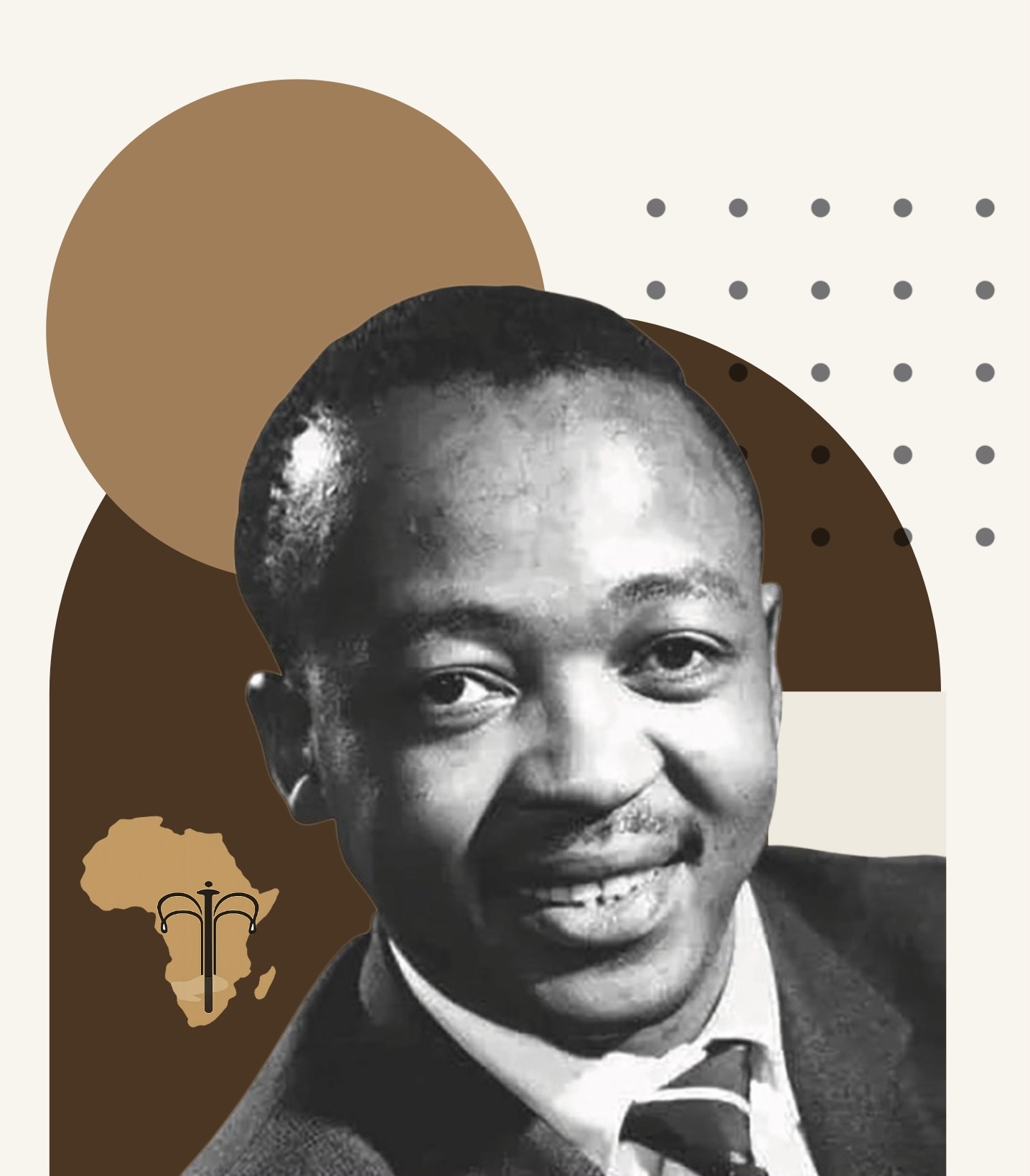
Philemon Pearce Dumasile Nokwe, 1927 to 1978
Teacher, advocate, Secretary-General of the ANC.
Born in Evaton to a shoemaker and a hotel worker. Taught at St Peter’s by OliverTambo. Dismissed from teaching for defying unjust laws. Admitted in 1956 as the firstAfrican advocate of the Transvaal Supreme Court, and barred in the same year from taking chambers beside his colleagues.
Arrested for treason, banned, detained and driven into exile, he served his people at the OAU and the United Nations until his death in Lusaka in 1978. He was fifty.
Born on 13 May in Evaton. His father was a cobbler and his mother made up beds in hotels.
[/disq_timeline_item][disq_timeline_item title=”1942 to 1946″ _builder_version=”4.27.9″ _module_preset=”default” global_colors_info=”{}”]
Schooled at St Peter’s in Johannesburg, where Oliver Tambo taught him.
[/disq_timeline_item][disq_timeline_item title=”1949″ _builder_version=”4.27.9″ _module_preset=”default” global_colors_info=”{}”]
Graduated BSc from Fort Hare, where he helped to found the Youth League branch on campus.
[/disq_timeline_item][disq_timeline_item title=”1951″ _builder_version=”4.27.9″ _module_preset=”default” global_colors_info=”{}”]
Began teaching mathematics in Krugersdorp.
[/disq_timeline_item][disq_timeline_item title=”1952″ _builder_version=”4.27.9″ _module_preset=”default” global_colors_info=”{}”]
Jailed in the Defiance Campaign for entering Germiston location without a permit, and dismissed from teaching.
[/disq_timeline_item][disq_timeline_item title=”1953″ _builder_version=”4.27.9″ _module_preset=”default” global_colors_info=”{}”]
Travelled abroad with Walter Sisulu. Served as secretary of the ANC Youth League until 1958.
[/disq_timeline_item][disq_timeline_item title=”1954″ _builder_version=”4.27.9″ _module_preset=”default” global_colors_info=”{}”]
Banned under the Suppression of Communism Act and confined to Johannesburg.
[/disq_timeline_item][disq_timeline_item title=”1955″ _builder_version=”4.27.9″ _module_preset=”default” global_colors_info=”{}”]
Completed his law degree at Wits by evening lectures, catching the last train home to Orlando West at nine.
[/disq_timeline_item][disq_timeline_item title=”1956″ _builder_version=”4.27.9″ _module_preset=”default” global_colors_info=”{}”]
Admitted as the first African advocate in the Transvaal. Refused a permit for chambers in town. Arrested for treason on 5 December.
[/disq_timeline_item][disq_timeline_item title=”1958″ _builder_version=”4.27.9″ _module_preset=”default” global_colors_info=”{}”]
Elected Secretary-General of the ANC at the age of thirty-one.
[/disq_timeline_item][disq_timeline_item title=”1960″ _builder_version=”4.27.9″ _module_preset=”default” global_colors_info=”{}”]
Detained for five months during the state of emergency.
[/disq_timeline_item][disq_timeline_item title=”1961″ _builder_version=”4.27.9″ _module_preset=”default” global_colors_info=”{}”]
Acquitted with the last thirty accused in the Treason Trial, in which he had also helped the defence.
[/disq_timeline_item][disq_timeline_item title=”1963″ _builder_version=”4.27.9″ _module_preset=”default” global_colors_info=”{}”]
Left the country on the instruction of the underground leadership, crossing into Bechuanaland with Moses Kotane.
[/disq_timeline_item][disq_timeline_item title=”1963 to 1978″ _builder_version=”4.27.9″ _module_preset=”default” global_colors_info=”{}”]
Spoke for the ANC at the OAU and the United Nations and on Radio Freedom. Secretary-General until 1969.
[/disq_timeline_item][disq_timeline_item title=”1978″ _builder_version=”4.27.9″ _module_preset=”default” global_colors_info=”{}”]
Died in Lusaka on 12 January, aged fifty.
[/disq_timeline_item][disq_timeline_item title=”2009″ _builder_version=”4.27.9″ _module_preset=”default” global_colors_info=”{}”]
A bronze bust unveiled at the entrance to our chambers on 5 December.
[/disq_timeline_item][disq_timeline_item title=”2025″ _builder_version=”4.27.9″ _module_preset=”default” global_colors_info=”{}”]
Brought home and reburied with his wife, Vuyiswa “Tiny” Nokwe, at Westpark Cemetery in Johannesburg on 17 May.
[/disq_timeline_item][/disq_timeline]
A cup of tea
When Nokwe applied to join the Johannesburg Bar, a small minority of members objected. One asked the Bar Council to reconsider his admission. The Council, with Issy Maisels QC in the chair and Bram Fischer QC at the table, answered on 26 March 1956.
“… as the Constitution of the Society clearly states that there shall be no colour Bar, the Council, even if it desired to do so, could not accede to this request.”
The objectors changed their ground. If Nokwe set foot in the common room, theysaid, they would call in the Group Areas inspectors and have him arrested. The Bar left the decision to him, and that angered him. He put it to the leaders of the ANC.Walter Sisulu asked whether the chance to break the barrier should be lost for the sake of a cup of tea.
Nokwe stayed out of the common room and kept his place at the Bar. Many yearslater Sydney Kentridge walked Ismail Mahomed into that room. George Bizos SC, whohad shared his own chambers with Nokwe, finished the story in 2009.
“The world did not come to an end. It was too late for Duma to have that cup of tea.He had gone into exile.”
The lawyer
Nokwe had little time to practise, and he used all of it. He defended people charged under the pass laws. When a policeman assaulted him, he sued and was awardeddamages. In the Treason Trial he sat in the dock as an accused and worked with the defence team as a lawyer.
“He used his knowledge of the law as an instrument to fight for human rights.” – President Jacob Zuma, at the unveiling of the bust, 5 December 2009
In his own words
“I come from a very ordinary family. My mother used to work in hotels, making up beds, and my father was a cobbler. … But I found they understood the importance of giving me the education which I have, under very grave difficulties; education which they never enjoyed.”
– Duma Nokwe, interviewed in Dar es Salaam, 29 October 1970
Remembered
At his funeral in Lusaka, Joshua Nkomo began with a proverb that played on his name. Laduma libalele: the sky thundered, though there was no cloud in sight.
Oliver Tambo said that he had taught Nokwe at school, and that in politics he had become Nokwe’s student.
His children remember a father who asked their mother to buy sweets for the young people arriving in Lusaka after June 1976. They were children, he said, and were owed some part of their childhood.
A memorial to him stands outside the Johannesburg High Court in Pritchard Street. His bust stands at our door.